- Italy’s culinary identity isn’t built on recipes alone, it’s rooted in the soil, the seed, and centuries of agricultural tradition.
- Yet right now, that tradition stands at a crossroads.
- As global food systems push toward uniformity, Italian heritage produce faces both serious threats and a quiet, powerful revival.
- So here’s what the future looks like — and why it matters for every food lover.
- What Counts as “Heritage Produce”?
Italy’s culinary identity isn’t built on recipes alone, it’s rooted in the soil, the seed, and centuries of agricultural tradition. Yet right now, that tradition stands at a crossroads.
As global food systems push toward uniformity, Italian heritage produce faces both serious threats and a quiet, powerful revival. So here’s what the future looks like — and why it matters for every food lover.
What Counts as “Heritage Produce”?
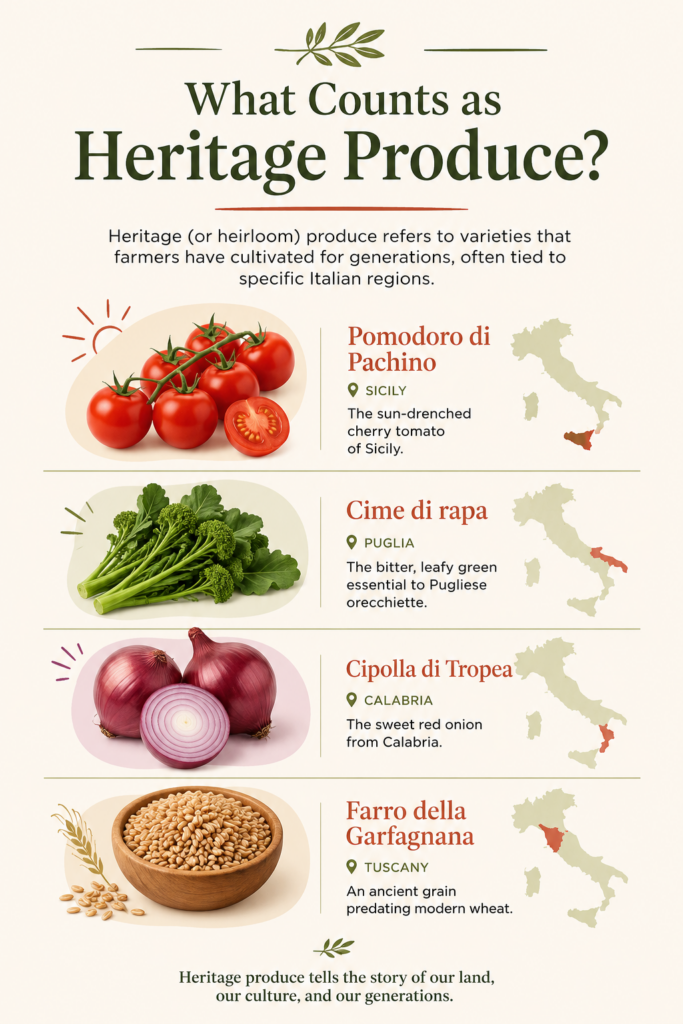
Heritage (or heirloom) produce refers to varieties that farmers have cultivated for generations, often tied to specific Italian regions. For example:
- Pomodoro di Pachino — the sun-drenched cherry tomato of Sicily
- Cime di rapa — the bitter, leafy green essential to Pugliese orecchiette
- Cipolla di Tropea — the sweet red onion from Calabria
- Farro della Garfagnana — an ancient Tuscan grain predating modern wheat
These aren’t just ingredients. In fact, they’re living archives of Italian food culture.
The Threats Facing These Varieties
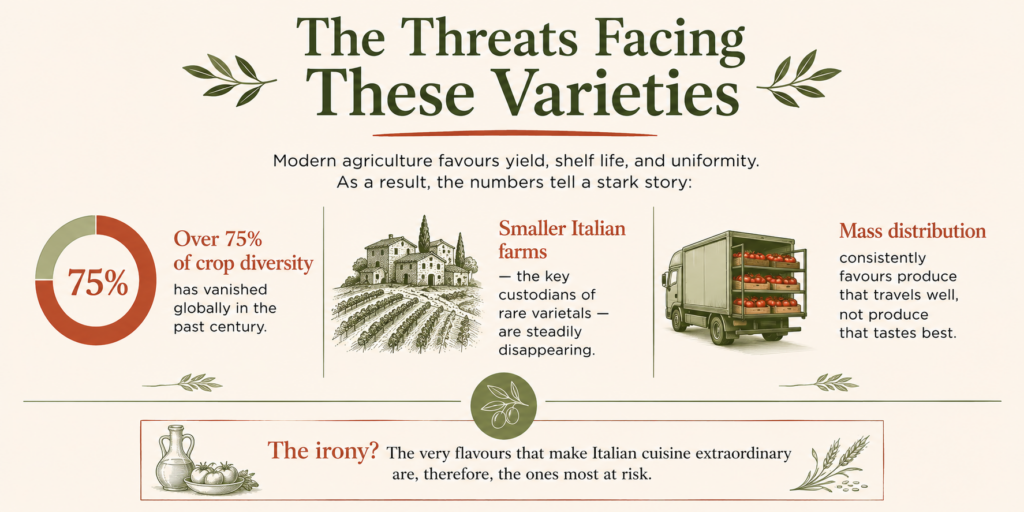
Modern agriculture favours yield, shelf life, and uniformity. As a result, the numbers tell a stark story:
- Over 75% of crop diversity has vanished globally in the past century
- Smaller Italian farms — the key custodians of rare varietals — are steadily disappearing
- Mass distribution consistently favours produce that travels well, not produce that tastes best
The irony? The very flavours that make Italian cuisine extraordinary are, therefore, the ones most at risk.
Why the Tide Is Turning
Fortunately, a meaningful counter-movement is gaining ground.
Slow Food’s Ark of Taste has catalogued hundreds of at-risk Italian ingredients, thereby putting them on the map for chefs, importers, and conscious consumers worldwide. Furthermore, Italy’s DOP and IGP certification systems actively protect regional specificity — ensuring that true San Marzano tomatoes can only come from the volcanic plains of Campania.
Meanwhile, a new generation of Italian farmers now chooses heritage over hybrid, driven by both cultural pride and the growing premium market for authentic flavour.
Heritage Produce vs. Commercial Equivalents
| Variety | Heritage Characteristic | Commercial Alternative |
|---|---|---|
| San Marzano Tomato | Low acidity, dense flesh, complex flavour | Generic plum tomato |
| Sicilian Blood Orange | Deep pigment, bittersweet, aromatic | Standard navel orange |
| Farro Monococco | Nutty, high protein, ancient grain | Modern durum wheat |
| Tropea Onion | Naturally sweet, mild raw | Common red onion |
The difference isn’t just taste — it also extends to nutritional density, biodiversity, and cultural continuity.
What This Means for You as a Consumer
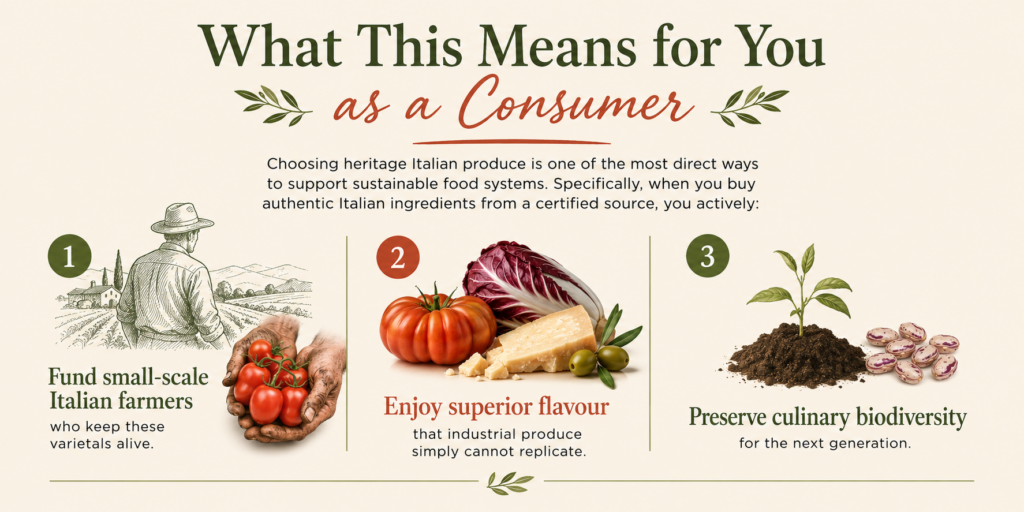
Choosing heritage Italian produce is one of the most direct ways to support sustainable food systems. Specifically, when you buy authentic Italian ingredients from a certified source, you actively:
- Fund small-scale Italian farmers who keep these varietals alive
- Enjoy superior flavour that industrial produce simply cannot replicate
- Preserve culinary biodiversity for the next generation
Consequently, at Bella Vita Foods, every product undergoes careful selection — tracing its origin, respecting its terroir, and bringing Italy’s most authentic flavours directly to your table.
The Outlook: Cautiously Optimistic
Overall, the future of Italian heritage produce depends on demand — and demand is clearly growing. Michelin-starred restaurants, artisan importers, and a rising class of ingredient-conscious home cooks are all leaning into provenance.
However, awareness remains key. The more people ask where does this come from and is this the real thing, the stronger the case becomes for protecting these irreplaceable varieties.
Italy’s culinary legacy doesn’t just live in its kitchens. It starts in the field and that’s precisely where we must protect it.
FAQs: Italian Heritage Produce
1. What is Italian heritage produce?
Simply put, it refers to traditional, region-specific fruit, vegetable, and grain varieties that Italian farmers have cultivated for generations — prized for their unique flavour, history, and cultural significance.
2. Is heritage produce more nutritious than regular produce?
Often, yes. Many heritage varieties retain higher levels of antioxidants, minerals, and flavour compounds. In contrast, modern commercial crops lose these qualities through selective breeding for yield and shelf life.
3. What does DOP mean on Italian produce?
DOP (Denominazione di Origine Protetta) is an EU certification that guarantees a specific Italian region produced and processed the product using traditional methods. In other words, it’s your clearest assurance of authenticity.
4. Where can I buy authentic Italian heritage ingredients in India?
Specialist Italian food importers like Bella Vita Foods source certified, origin-traceable Italian produce — and therefore offer far more reliability than generic supermarket alternatives.
5. Why are some Italian heritage varieties disappearing?
Industrial farming prioritises uniformity and long shelf life over taste and tradition. As a result, without conscious consumer demand and protective certifications, rare regional varieties simply stop being grown.
Explore our range of authentic Italian heritage ingredients at bellavitafoods.com