- If you’ve ever tasted a dish that felt inexplicably deep, savory, and satisfying, the kind where you keep reaching for another bite without knowing why — umami was doing the heavy lifting.
- In fact, among Italian mushrooms, few deliver that sensation as cleanly, or as memorably, as the Pioppini.
- Pioppini (Agrocybe aegerita), also called black poplar mushrooms, grow wild in clusters along poplar tree stumps across northern and central Italy.
- Their umami intensity isn’t accidental — it’s deeply biological, shaped by both the species itself and the environment it grows in.
- Specifically, these mushrooms are naturally rich in: Glutamates — the free amino acids behind classic savory depth 5′-ribonucleotides — flavor compounds that multiply glutamate’s effect synergistically Ergothioneine — a heat-stable antioxidant that also contributes to overall savory complexity The result?
If you’ve ever tasted a dish that felt inexplicably deep, savory, and satisfying, the kind where you keep reaching for another bite without knowing why — umami was doing the heavy lifting. In fact, among Italian mushrooms, few deliver that sensation as cleanly, or as memorably, as the Pioppini.
What Makes Pioppini So Intensely Savory?
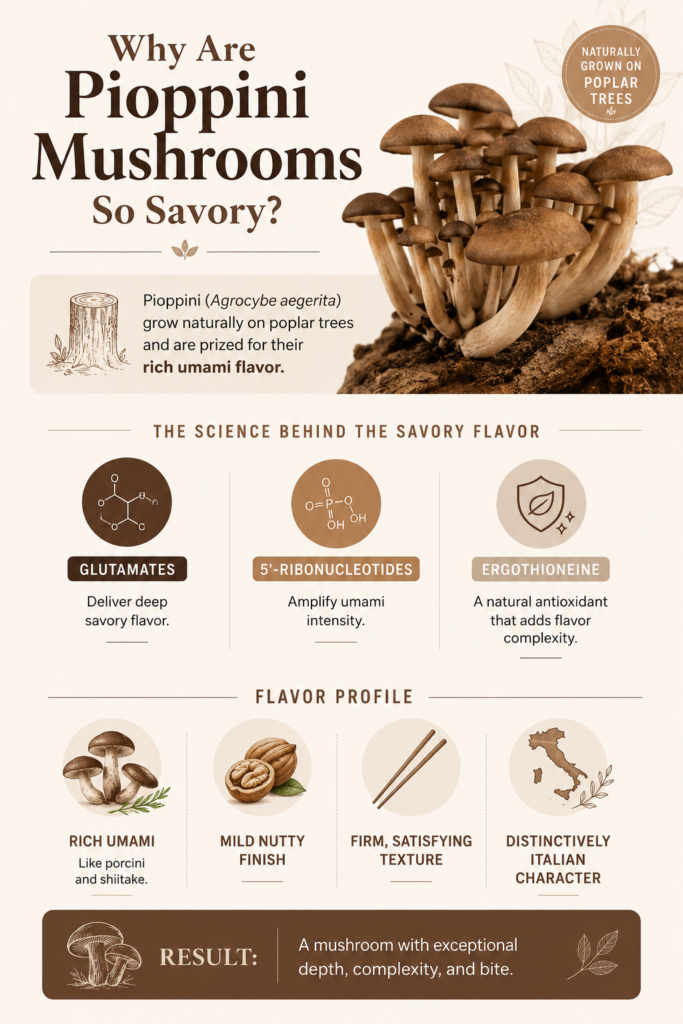
Pioppini (Agrocybe aegerita), also called black poplar mushrooms, grow wild in clusters along poplar tree stumps across northern and central Italy. Their umami intensity isn’t accidental — it’s deeply biological, shaped by both the species itself and the environment it grows in.
Specifically, these mushrooms are naturally rich in:
- Glutamates — the free amino acids behind classic savory depth
- 5′-ribonucleotides — flavor compounds that multiply glutamate’s effect synergistically
- Ergothioneine — a heat-stable antioxidant that also contributes to overall savory complexity
The result? A flavor profile that sits somewhere between porcini and shiitake — but with a firmer, more satisfying bite and a slightly nutty finish that feels unmistakably, authentically Italian.
The Flavor Notes, Layer by Layer
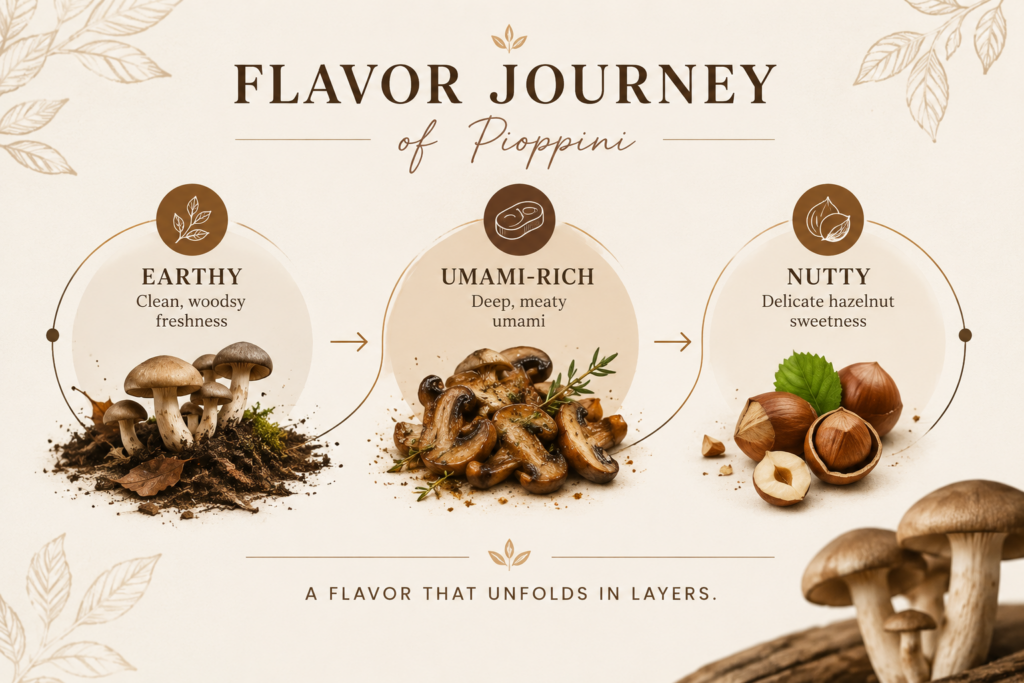
Pioppini don’t taste like a single thing. Instead, their profile builds gradually across the palate in distinct, recognizable stages.
On the front: A clean, woodsy earthiness — think damp forest floor after an autumn rain somewhere in the Apennines.
In the middle: Rich, meaty depth with no bitterness whatsoever. This is where the glutamates do their quiet, powerful work.
On the finish: A subtle hazelnut sweetness lingers long after the bite, particularly when sautéed in high-quality Italian extra-virgin olive oil.
This layered complexity is exactly why Italian home cooks and professional chefs have been building pasta sauces, slow risottos, and braised dishes around Pioppini for generations. Simply put, they don’t just add flavor to a dish — they anchorit.
How Cooking Unlocks Their Full Umami Potential
Raw Pioppini are relatively mild. However, heat transforms them entirely and dramatically.
| Cooking Method | Umami Intensity | Best Use |
|---|---|---|
| Sautéed in olive oil | ★★★★★ | Pasta, bruschetta, eggs |
| Slow-braised | ★★★★☆ | Stews, meat accompaniments |
| Grilled over flame | ★★★★☆ | Antipasto, vegetable sides |
| Simmered in broth | ★★★☆☆ | Soups, risotto base |
High heat triggers the Maillard reaction, concentrating glutamates and significantly deepening overall flavor. As a result, a simple sauté with garlic, good olive oil, and a pinch of sea salt is often all you need — the mushrooms confidently take care of everything else.
Why Italian-Grown Pioppini Are in a Class of Their Own
Terroir matters for mushrooms just as much as it does for wine or olive oil. Indeed, Italian Pioppini cultivated in the Po Valley and around the Apennine foothills develop their distinctive umami richness from a precise combination of factors that simply can’t be replicated elsewhere:
- Mineral-rich, well-drained soil around traditional poplar groves
- Seasonal temperature shifts that slow natural growth and concentrate flavor compounds over time
- Small-batch harvesting at peak cluster maturity, before texture and flavor begin to degrade
By contrast, commercially cultivated Pioppini from outside Italy tend to be noticeably milder, less complex, and largely missing that characteristic nutty finish. The difference isn’t subtle — it’s immediately apparent from the very first bite.
At BellaVita Foods, we source Pioppini directly from Italian growers who understand this balance intimately — therefore delivering their full, uncompromised flavor profile to US distributors, specialty grocers, and restaurant buyers who refuse to settle for less.
When you taste a Pioppini grown the Italian way, you’re not simply tasting a mushroom. You’re tasting the soil, the season, and centuries of quiet culinary instinct passed down through generations.
FAQs
Q: What does umami taste like in Pioppini mushrooms? It’s a deep, meaty savoriness — satisfying in a way that can’t be explained by salt or fat alone.
Q: Are Pioppini the same as porcini mushrooms? No. Pioppini are firmer and nuttier, with a cleaner umami that won’t overpower delicate dishes.
Q: Can you eat Pioppini mushrooms raw? Technically yes, but cooking dramatically enhances their umami compounds and significantly improves digestibility.
Q: Why do Italian Pioppini taste better than standard supermarket varieties? Italian soil, climate, and careful harvest timing produce higher glutamate concentrations — which directly translates to noticeably richer, deeper flavor.
Q: Where can US distributors source authentic Italian Pioppini? BellaVita Foods imports them directly from Italy — connect at bellavitafoods.com.