- Close your eyes and picture this: a sun-warmed Sicilian morning, the air thick with the scent of orange blossom, and somewhere in the distance, the steady, ancient presence of Mount Etna, still breathing, still shaping everything around it.
- It’s the reason the food tastes the way it does.
- Sicily has always been a land of contrasts.
- And at the heart of it all sits Etna, Europe’s most active volcano, quietly doing something extraordinary to the soil beneath it.
- Farmers here have understood this for centuries.
Close your eyes and picture this: a sun-warmed Sicilian morning, the air thick with the scent of orange blossom, and somewhere in the distance, the steady, ancient presence of Mount Etna, still breathing, still shaping everything around it. This isn’t just a backdrop. It’s the reason the food tastes the way it does.
Sicily has always been a land of contrasts. Sea and mountain. Ancient and alive. And at the heart of it all sits Etna, Europe’s most active volcano, quietly doing something extraordinary to the soil beneath it. Farmers here have understood this for centuries. The rest of the world is only just catching on.
What Volcanic Soil Actually Does
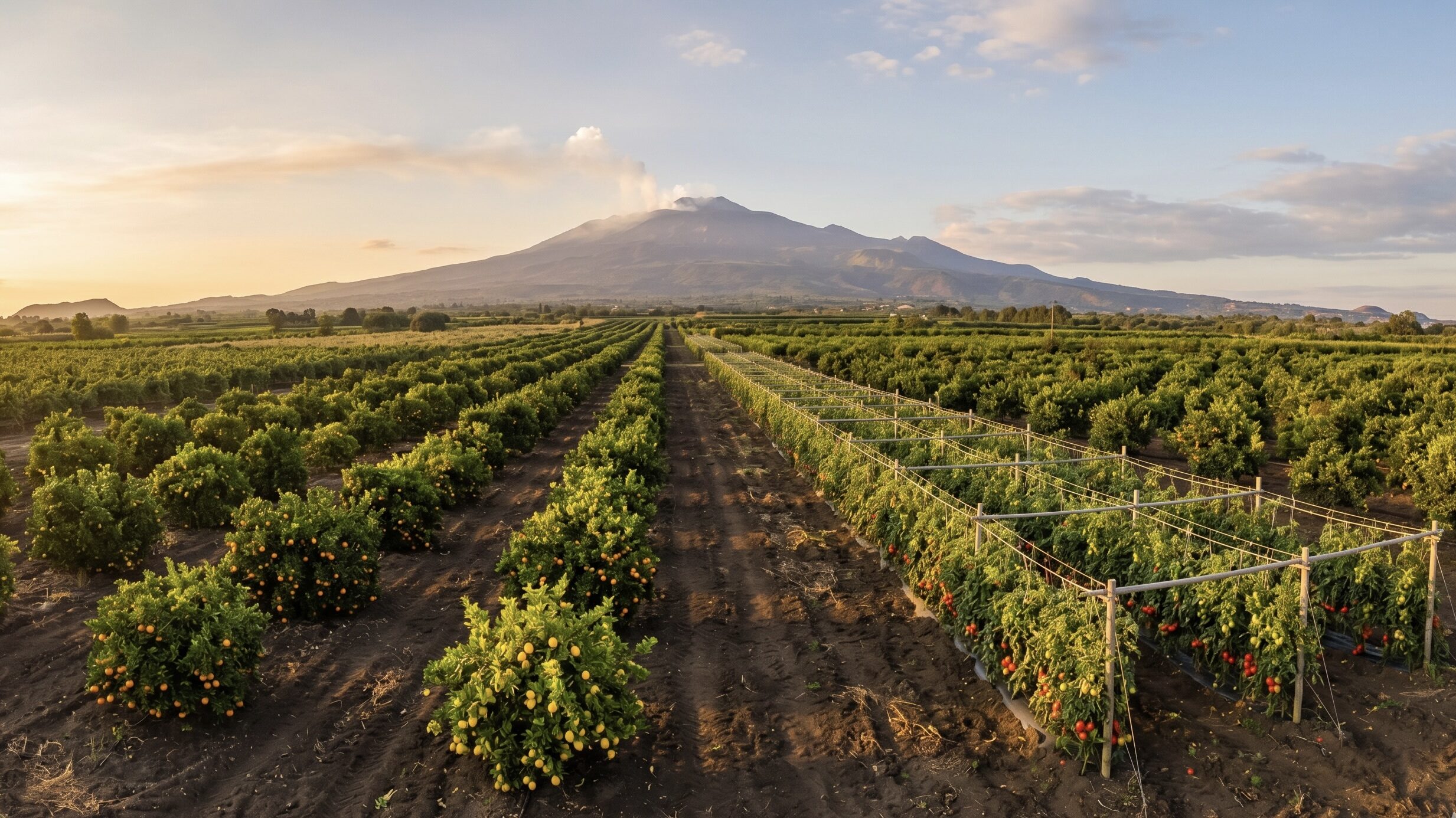
When lava cools and breaks down over thousands of years, it leaves behind something remarkable: soil packed with minerals like potassium, phosphorus, magnesium, and iron. These aren’t just elements on a chemistry chart. They’re the building blocks of flavour.
Plants grown in this kind of earth absorb those minerals deeply and slowly. The result is produce that tastes more concentrated, more vivid, more like itself. A tomato grown on Etna’s slopes doesn’t just taste like a tomato. It tastes like the best version of one you’ve ever had.
There’s also the matter of drainage. Volcanic soil is naturally porous, which means water moves through it freely rather than pooling. Roots are forced to reach deeper, seeking moisture through layers of ancient rock. That gentle, constant effort pushes plants to develop richer sugars and more complex aromas. It’s the same principle behind why a vine that struggles a little often produces the most extraordinary wine.
The Taste You Can Trace Back to the Mountain
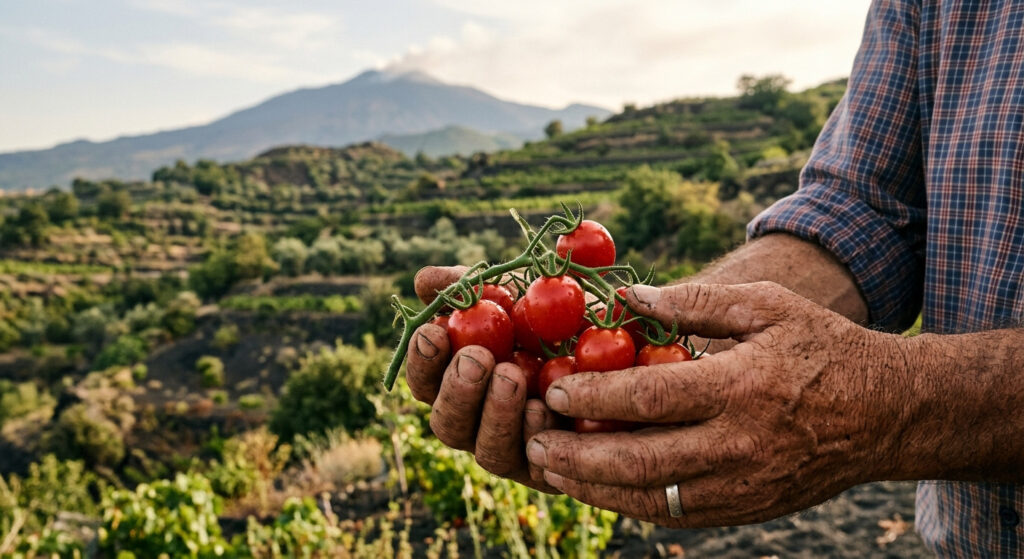
Ask any farmer working the land around Catania or the villages dotting the Etna DOC zone, and they’ll tell you the same thing: this soil has memory. Generations of families have cultivated it, understanding intuitively what science is only now beginning to confirm.
The blood oranges of this region, the celebrated Arancia Rossa di Sicilia, carry a depth of sweetness and a lingering tartness you simply won’t find in citrus grown anywhere else. Etna’s cherry tomatoes burst with an intensity that borders on candy-like richness. And the olive oils pressed from groves rooted in this volcanic earth have a peppery, grassy finish that stays with you long after the last bite.
Then there’s the wine. The Nerello Mascalese grape, grown on Etna’s ancient terraced vineyards, has become one of the most talked-about varieties in the world, and it’s largely because of what the soil gives it: elegance, a distinct mineral edge, and a sense of somewhere. You don’t just taste the grape. You taste the mountain.
This is what the French call terroir, the idea that the land leaves its fingerprint on everything grown within it. On Etna, that fingerprint is unmistakable and deeply personal. It belongs to the place and nowhere else.
A Living Landscape, Still Giving
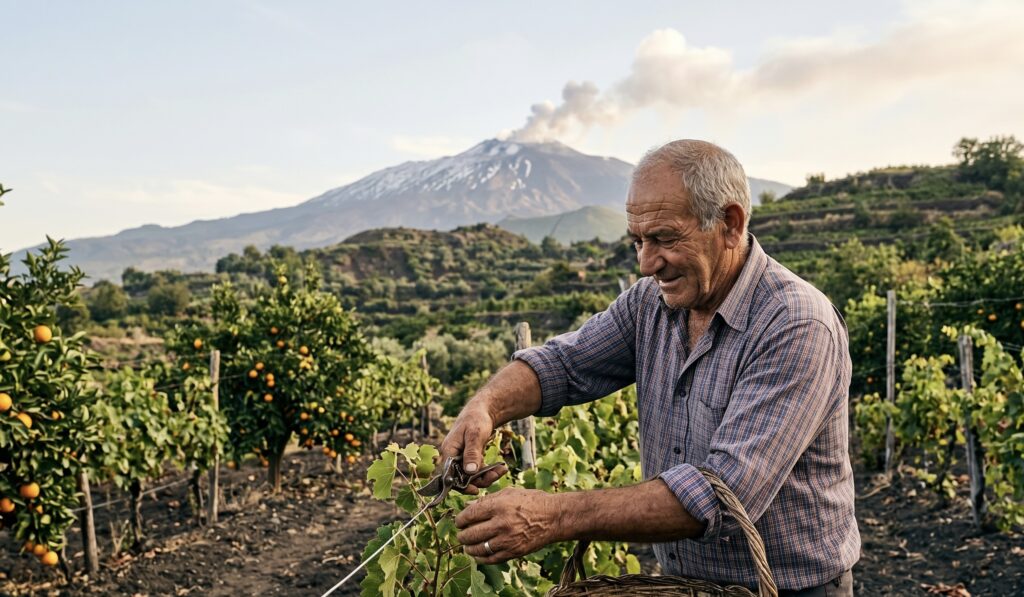
What makes Etna’s volcanic soil benefits so enduring is that they are, quite literally, ongoing. The mountain is still active, still occasionally sending fresh mineral-rich material across the landscape. In a quiet, geological sense, it is continuously renewing its gift to the farmers who live and work in its shadow.
There’s something deeply moving about that. Sicilian produce shaped by forces older than agriculture itself, tended by people who’ve passed down their knowledge of this land across generations. Mount Etna agriculture isn’t just a farming method. It’s a living relationship between people, place, and earth.
And you can taste it.
The next time you bite into a Sicilian tomato or sip an Etna Rosso, pause for just a moment. Notice the brightness, the warmth, the slight mineral wildness underneath it all. That’s the mountain in there, ancient, alive, and entirely irreplaceable. What ingredient has ever made you stop and wonder about the place it came from?
Taste the difference Etna’s soil makes. Explore our Sicilian produce at Bellavita Foods.